You can call 811 directly or use our web-based ticket system, Single Address Ticket (SAT)
Professional excavators who create more complex and multiple locate requests can use
CENTER LOGiX.
Have the following information ready when you contact 811:
Phone number
Address (including the county)
Is it in a subdivision?
A cross-street name (nearest intersecting street & is it within a 1/4 mile)
Where exactly is the area you wish to have located? (are you marking the area with white paint or flags) Learn more about white lining your excavation area.
Work date, time, how long will the work take, what type of work is it and who is it for?
For a full listing of required locate request information click here
You will be given a ticket number and a verbal list of utility companies that are notified by North Carolina 811. This does not mean each member listed owns buried utilities on your property. You will want to write down the names of the utility companies for easy reference. Every utility company is not a member of North Carolina 811.
Excavators must give notice no less than 3 full working days before starting work. For underwater facilities, the notice period is no less than 10 to 20 working days.
Below in this example the excavator contacted 811 on the 1st. During the call or while creating the CENTER LOGiX or SAT ticket the work start date is noted on the ticket. Three full working days prior to the work start date, locators will be dispatched to mark your excavation area. The life of the ticket begins on the Work start date and you are clear to dig for up to 28 calendar days.
LIFE OF A TICKET
*Working Day - Monday thru Friday. Note: Locates are normally performed on working days. *Calendar Days - Any day of the month, including weekends. You are clear to dig for 28 calendar days beginning on the work start date.
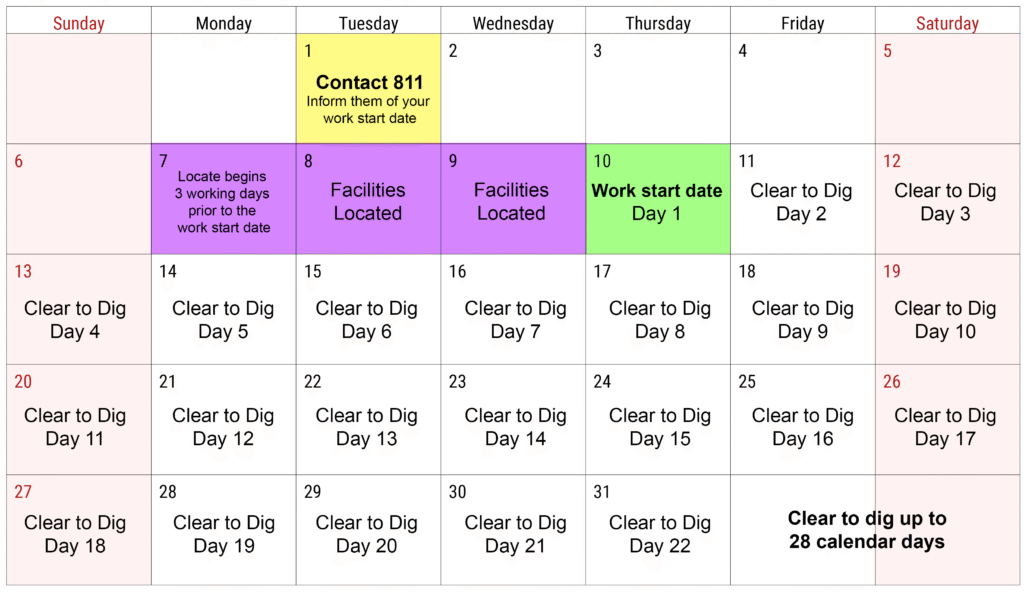
Weekends and Holiday can affect the locate process. Here are some examples. In graph 1 you see when the locate would be performed if the start date lands on a Wednesday. The locate would begin on Friday and continue thru Tuesday. In graph 2 you see what would happen if a holiday landed on a Friday during the locate process.
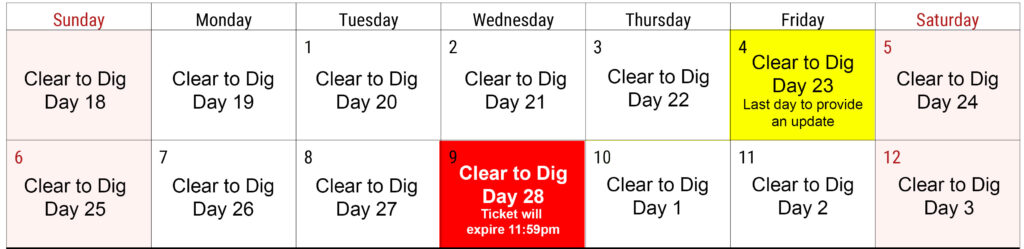
GRAPH 1
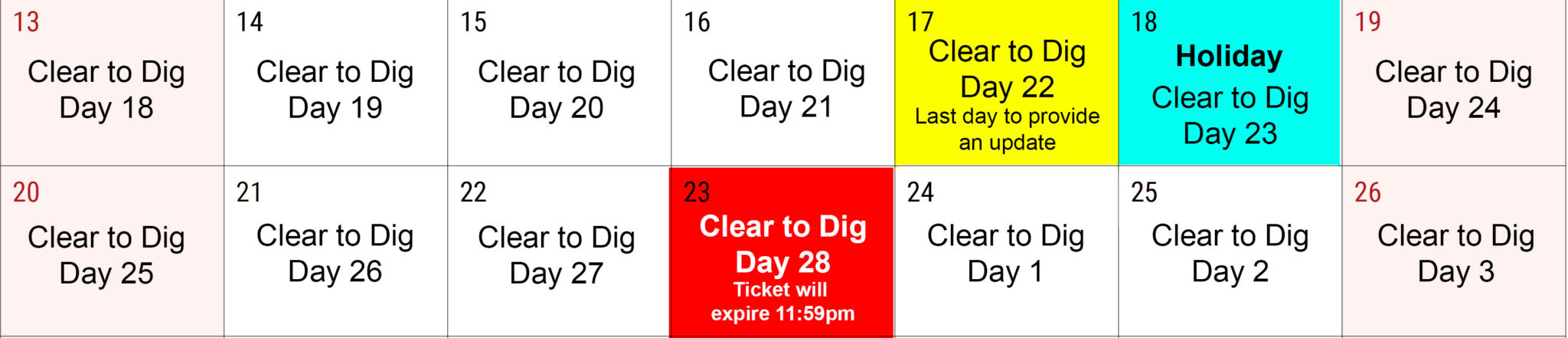
GRAPH 2
In order to extend the life of your ticket past the 28 calendar days you will need to submit a subsequent notice 3 full working days prior to the expiration date of your locate request. In this example you need to provide your updated no later than day 25 of your ticket. Locators then have day 26, 27 and 28 to update the locate request. When you submit your subsequent notice, do not include any areas of your excavation that have already been completed. After 11:59pm on day 28, your ticket will begin again, giving you another 28 calendar days for excavation to take place.
UPDATE A TICKET
Note: No excavation or demolition may continue after the 28-day period unless the person responsible for the excavation or demolition provides a subsequent notice which shall be provided in the manner as the original notice. If areas of your excavation have been completed, please do not include in the updated notice.
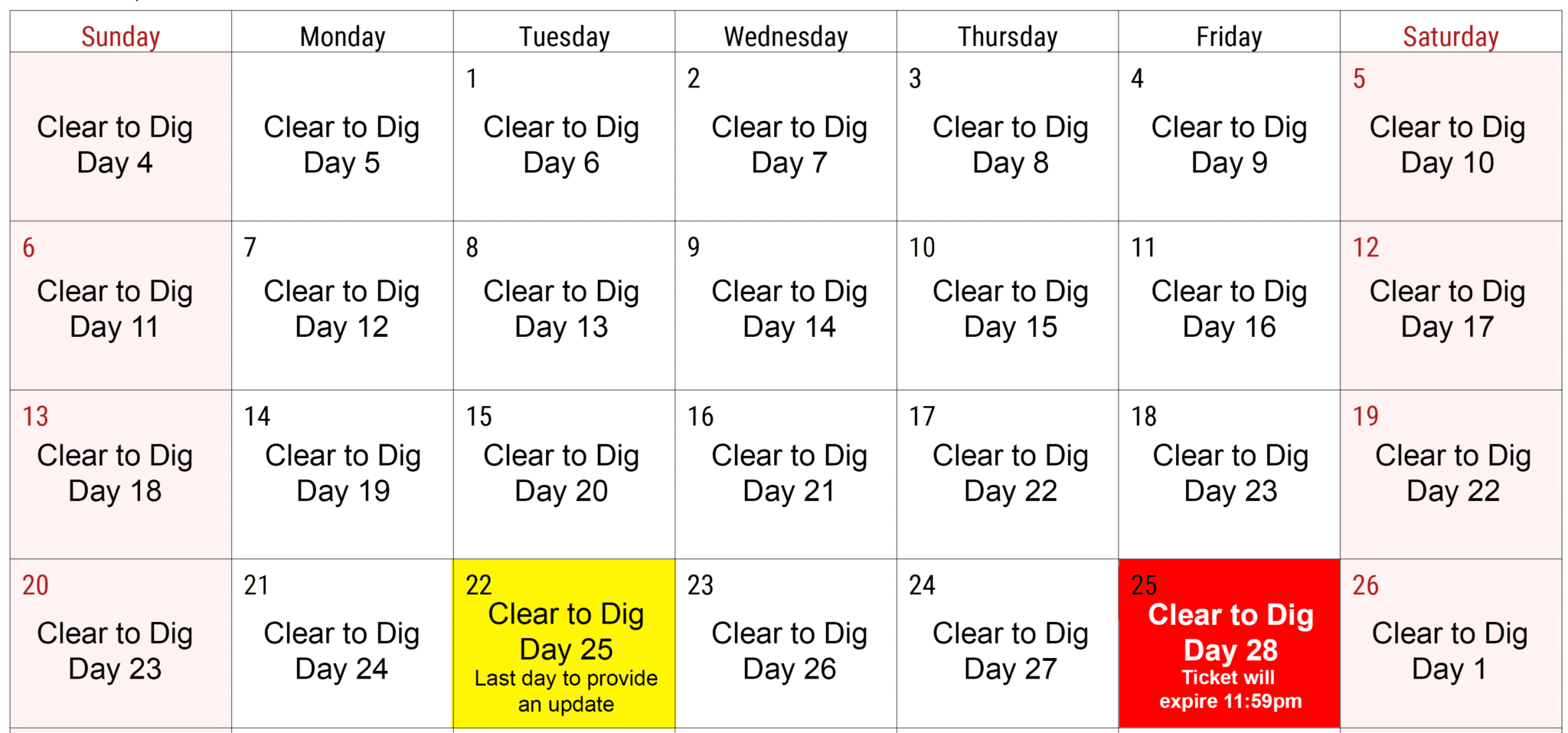
Weekends and Holiday can affect the update process too. Here are some examples. In Graph 1 we see that the 28th day of the ticket lands on a Wednesday. Since the update must be made on a working day, the ticket is updated on the 23rd day of the ticket, giving the locators 3 full working days to respond to the update, the 26th, 27th and 28th days of the ticket. In Graph 2 a holiday lands on a Friday so the update must now be made no later than the 22nd day of the ticket.
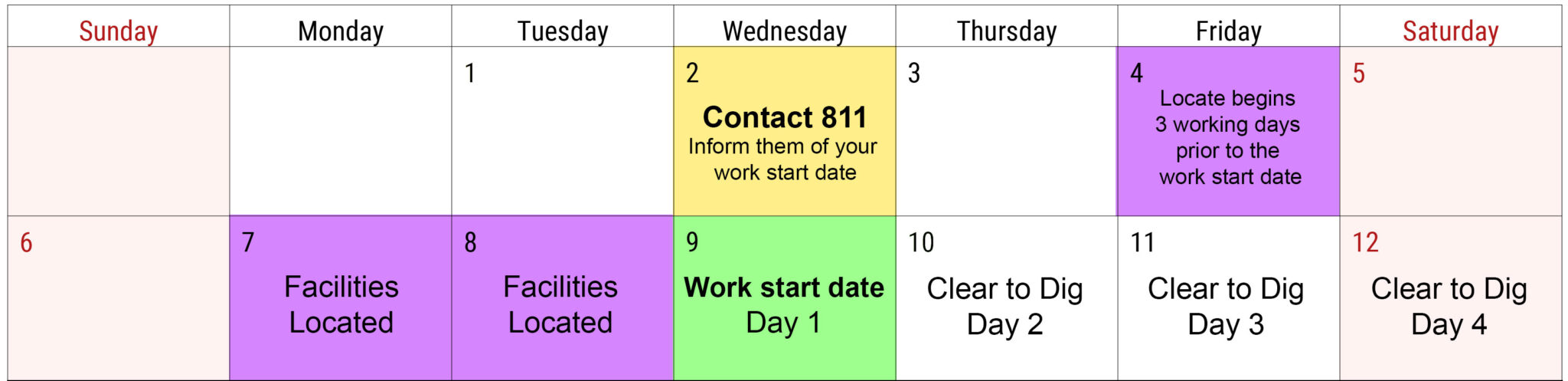 Graph 1
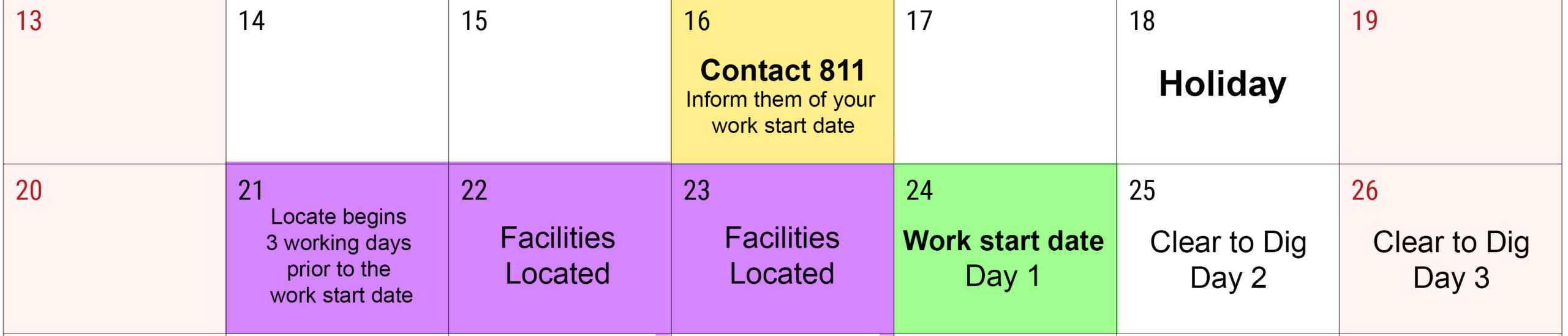 Graph 2
PLEASE BE AWARE:
PRIVATE LINES WILL NOT BE MARKED BY CONTACTING 811
What is a private line?
It is the responsibility of the excavator to contact a utility locating company to have any private lines located. The utility company determines public utility lines themselves, and the maintenance usually ends where the meter of the particular line is. Beyond the meter and up to the building or home, including the backyard, is then considered a private utility, for which the property owner is responsible.
The excavator bears the responsibility of reaching out to a utility locating company for the identification of any private lines. Public utility lines are determined by the utility company, and their maintenance typically concludes at the meter of the specific line. Areas beyond the meter, extending to the building or home are classified as private utilities. The property owner assumes responsibility for these private utilities.
Find a Private Line Locator
Positive Response is a means for the utility members of North Carolina 811 to provide information regarding the status of your location request. Have the facilities been marked? Does the locator need to meet with the contractor or are there no facilities in the area of excavation? There is no charge to the excavator in retrieving the information and members can save the cost of retransmitted location requests.
Check the status of your locate request
Your property’s underground facilities will be marked with color-coded paint, stakes, or flags. It is crucial not to disturb these markers once the underground facilities have been located. It’s advisable to communicate to young children that the brightly colored flags are not toys and should not be removed. Utilize the color code chart as a reference to identify the marked underground facilities.
The APWA uses a nationwide color-coding system for underground utility markings. White outlines the proposed excavation area, pink is used for temporary survey markings, red identifies electrical facilities, yellow marks gas and petroleum lines, orange indicates communication systems, blue designates potable water lines, green marks sewer and drainage systems, and purple identifies reclaimed water infrastructure.
The location tolerance zone width encompasses 24 inches horizontally on each side of the utility, in addition to the utility’s width. If excavation within the tolerance zone is necessary, it is advisable to proceed with caution and opt for manual digging to minimize the potential for damage to the located utility. NC811 does not possess information about the depth of the facilities. Facility owners follow their industry’s code when burying lines; nevertheless, variations in facility depths may arise due to installation practices, alterations in grade, soil erosion, and other factors that evolve over time.
In case of damage, it is essential to inform the facility owner directly, and you can call 811 to file a report on damage to underground facilities. If a gas product release occurs, promptly and safely relocate upwind and dial 911 to report the incident.